
Arts Centre Melbourne
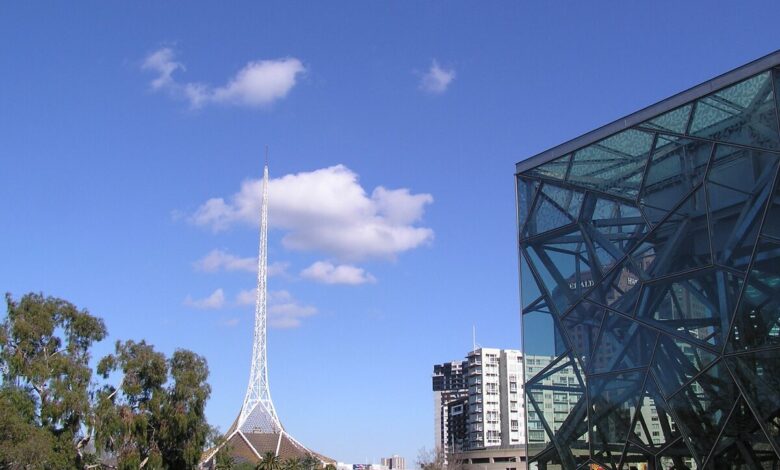
Arts Centre Melbourne — the country’s busiest arts precinct
Arts Centre Melbourne sits on the south bank of the Yarra River at the heart of the Southbank arts precinct, a five-minute walk from Flinders Street Station and adjacent to the National Gallery of Victoria, the Australian Centre for Contemporary Art, the Sidney Myer Music Bowl and the Melbourne Recital Centre. The complex opened in stages between 1982 and 1984 to a Roy Grounds design — the iconic spire above the Theatres Building was added in 1996 — and is the principal home of the Melbourne Symphony Orchestra, The Australian Ballet, Opera Australia (Melbourne season), and Victorian Opera. It runs more performances per year — across all genres — than any other arts venue in Australia.
The rooms
- Hamer Hall — 2,464 seats. The Melbourne Symphony Orchestra’s home, also used for the major touring orchestras, world music, and contemporary acts that suit the room. Acoustically rebuilt 2010–2012 with a redesigned reflector array, replaced wall surfaces and a new orchestra shell; the result is the country’s busiest serious-music room.
- State Theatre — 2,079 seats. Australia’s largest opera and ballet house. Opera Australia Melbourne and The Australian Ballet share the main season here; international ballet companies and large-scale touring opera fill the rest. Better sightlines and bigger room than the Sydney Joan Sutherland Theatre but acoustically drier — the production’s amplification choices matter more here.
- Playhouse — 884 seats. Used for theatre, dance, contemporary work and selected smaller-scale ballet. Excellent sightlines throughout.
- Fairfax Studio — 374 seats. Configurable theatre space — used for chamber theatre, cabaret, contemporary work, and Bell Shakespeare’s Melbourne smaller-format productions.
Adjacent to the main Theatres Building is the Sidney Myer Music Bowl — a 12,000-capacity outdoor amphitheatre in Kings Domain — used for the MSO’s free summer concert series, Carols by Candlelight, and selected major touring acts.
Acoustics and seat selection
Hamer Hall: front-half stalls are the warmest seats; circle middle gives a balanced overview. The rear stalls have a known acoustic dryness left over from the original 1980s design that the 2012 redevelopment improved without fully solving — avoid them for symphonic work. Choir stalls behind the orchestra are the cheapest reliable serious-listening seats.
State Theatre: front-half stalls and dress circle middle are the high-value seats. The room’s depth means rear-stalls audiences sit further from the stage than they would in the Joan Sutherland Theatre — for opera, prefer dress circle middle over rear stalls. Avoid the side dress circle at the very edge — sightlines cut to two-thirds of the stage.
Playhouse and Fairfax Studio: smaller rooms, excellent throughout — stalls front-half or circle middle for tall audiences.
Getting there and what to do nearby
Train to Flinders Street and walk across Princes Bridge (5 minutes). Tram on routes 70, 75, 1, 3 along St Kilda Road. The on-site car park is large and reasonably priced compared to Sydney Opera House parking; book online for the best rate. The Eastern car park behind the Theatres Building is the closer entry for major productions.
Pre- and post-show dining: the precinct is dense with options. On-site, the Yarra Restaurant in the Theatres Building suits a pre-curtain meal; the Stalls Bar is the standard interval pour. Walking radius: Vue de Monde (Rialto, 15 min), Florentino (15), Becco (10), Coda (10), MoVida (10). Federation Square is a five-minute walk for casual dining, ACMI for an exhibition before the show, and the National Gallery of Victoria is a two-minute walk for a daytime pairing.
Good to know
The Arts Centre offers backstage tours (book through the website), the Australian Performing Arts Collection (the country’s main archival collection of performing arts costumes and props, with rotating displays in the public foyers), and the Sidney Myer Music Bowl free summer programme through January and February. The accessibility programme includes lift access throughout, hearing-loop technology, and a substantial audio-description, captioned and Auslan programme across all major-company seasons. The complex sits at the geographical heart of Melbourne’s arts walking circuit — a comfortable single-day pairing covers Arts Centre matinee, NGV International afternoon, and an evening at the Melbourne Recital Centre two minutes around the corner.