Adelaide Festival Centre
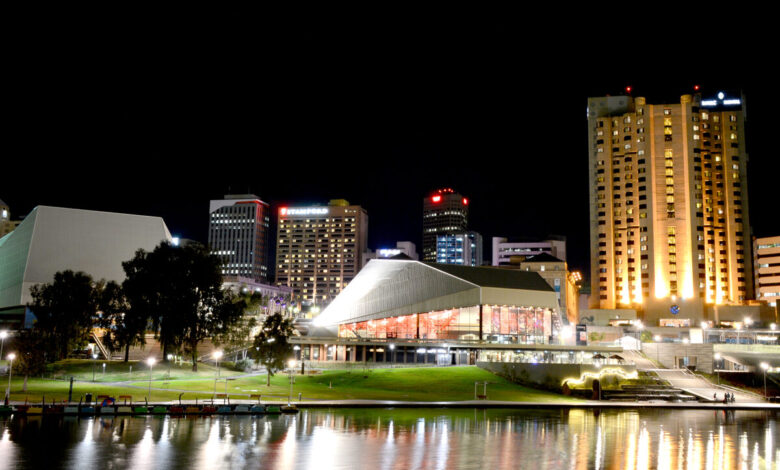
Adelaide Festival Centre — Australia’s first capital-city arts centre
Adelaide Festival Centre opened in June 1973 — four months ahead of the Sydney Opera House — making it Australia’s first capital-city multi-purpose arts centre. The complex sits on the south bank of the Torrens River alongside Government House and Parliament House, a five-minute walk from Adelaide CBD’s Rundle Mall. It is the cultural hub for Adelaide Festival and the Adelaide Cabaret Festival (OzAsia Festival held its final edition here in 2026), and the principal home of State Theatre Company South Australia and the Adelaide Symphony Orchestra (Festival Theatre season). The complex has been progressively refurbished: the Festival Plaza redevelopment has been rebuilding the public spaces around it since 2016 (its first and largest stage opened in March 2022), and a major refit of the three theatres, with new Festival Theatre seating, reopened them for the Adelaide Festival in February 2026.
The rooms
- Festival Theatre — Close to 2,000 seats. The principal large-scale venue, used for opera (State Opera South Australia and Adelaide Festival opera commissions), ballet (touring Australian Ballet and Adelaide Festival contemporary dance), the major Adelaide Festival mainstage, and the Adelaide Symphony Orchestra’s larger-scale programmes. Acoustically broad — better suited to opera and large-scale theatre than to chamber-format symphonic work.
- Dunstan Playhouse — About 590 seats on two levels. State Theatre Company SA’s principal mainstage. Configurable apron, flexible seating layout. Used also for the Adelaide Festival theatre programming and selected cabaret events.
- Space Theatre — 350 seats, fully configurable. Black-box space for contemporary theatre, dance, and the Adelaide Cabaret Festival’s smaller-format programming.
- Festival Theatre Foyer and Plaza — used for free festival programming, outdoor events and the Adelaide Festival’s public-realm work.
Acoustics and seat selection
Festival Theatre: front-half stalls and dress circle middle. The room’s depth makes the rear stalls feel quite removed for theatre and dance — for the Adelaide Festival mainstage productions, prefer dress circle middle or front stalls. For the Adelaide Symphony’s symphonic programmes (which they share with the Adelaide Town Hall — the ASO’s true home for symphonic work), the Festival Theatre is the larger-scale alternative.
Dunstan Playhouse: excellent throughout — the configurable apron means seat layout varies by production. Front rows give the most intimate view; the rear of the stalls works well for productions with substantial set design.
Space Theatre: configurable; check the production’s seating diagram before booking. The black-box format means no bad seat for most configurations.
Getting there and what to do nearby
Walk from Rundle Mall (5 min north) or from any CBD hotel. Adelaide is a small, walkable capital — most CBD accommodation is within fifteen minutes’ walk of the Festival Centre. The Festival Car Park beside the centre is not run by the Festival Centre and access can be restricted, so pre-book or use one of the eight car parks within a ten-minute walk; the Adelaide Oval East car park is about nine minutes away, except on major Oval event days.
Pre- and post-show dining: the Festival Centre’s own restaurant, Angry Penguin, opened with the 2026 refit, overlooks the river and suits a pre-curtain meal. Within walking distance there are plenty of places to eat along North Terrace and in the East End around Rundle Street. North Adelaide’s O’Connell Street is a ten-minute taxi ride and offers a more residential dining experience.
Good to know
The Festival Centre’s accessibility programme covers comprehensive Auslan, audio-description and captioning during the major-festival seasons. Behind-the-scenes theatre tours are run for school groups; check the Festival Centre website for what is on offer. The complex is the geographical centre of the Adelaide Festival fortnight — much of the Festival programme happens here, in the adjacent Festival Plaza or elsewhere in the CBD, though some venues are further out (the 2026 programme also used venues in Hindmarsh and Norwood). Accommodation in early March books out months ahead; if Adelaide Festival is on your calendar, lock the hotel when the programme launches in October. The Festival Plaza redevelopment has added significantly to the public spaces and the dining offer; the riverbank itself is a pleasant pre-show walk.
Correction, 10 November 2026: We corrected factual errors in this article, including details such as dates, figures, names and venue information, after an editorial review.